1. The first meeting: Figuring out what's possible

Before you start looking at properties, it's worth taking some time to figure out what you want and what you can realistically afford. Start by thinking about your lifestyle, your priorities and your plans for the next few years.
Are you looking for a condo in the city, a townhouse with more space or a home with a yard? Do you need a second bedroom for a home office? Are you planning to start a family? How important is being close to transit, parks or work?
It's also helpful to decide when you'd ideally like to move. Are you hoping to buy within the next few months, or are you just starting to explore your options?
You don't need to have all the answers. The goal is to establish a starting point.
Ideally, you'll meet with a realtor early in the process. A realtor like us can help you put together a plan, explore different options and answer the questions that inevitably come up when you're buying for the first time.
Client Win: Last year, we met a couple who really wanted to stay in Yaletown. They loved the neighbourhood and wanted to be close to work, but they were also planning to start a family and needed more space.
We looked at transit connections that would allow them to get to work easily, compared the cost per square foot in Yaletown with nearby neighbourhoods and explored areas with more parks and green space.
After looking at the options, they realized that a neighbourhood outside Yaletown could give them a larger home, an easier family lifestyle and a commute that still worked for them. They were really happy with the final result!
2. Getting the finances in order and building a buying strategy

Getting pre-approved for a mortgage is one of the most important steps before you start looking at homes. Many buyers are surprised to discover that their actual buying power is different from what they initially expected. A mortgage pre-approval helps you understand how much you may be able to borrow, what your down payment requirements look like and what your estimated mortgage payments could be.
You can start by talking to your bank, or we'd be happy to recommend a mortgage broker who can guide you through the process.
A good mortgage broker can help you:
Understand your buying power: Figure out how much you may qualify to borrow and what purchase price makes sense for your situation.
Explore different mortgage products: Compare available mortgage options, interest rates and repayment terms.
Plan for your down payment: Understand how much you'll need to save and what options may be available to you.
Explore government programs: Learn about programs and incentives that may help you save money, including potential exemptions from certain taxes, if you qualify.
Prepare for a future purchase: If you're not ready to buy yet, get advice on how to improve your financial position and prepare for homeownership.
It's also important to remember that your mortgage payment is only one part of the cost of owning a home. You'll need to budget for property transfer tax, legal fees, home inspection costs, property taxes, insurance, strata fees if applicable, and ongoing maintenance.
And while you're preparing to buy, avoid making major financial changes without first speaking to your mortgage professional. Taking on a new car loan, making a large purchase or changing jobs could affect your mortgage application or borrowing capacity.
Client Win: One of our buyers initially planned to purchase a home around $900,000. During our financial planning, we discovered they could qualify for a full Property Transfer Tax exemption through BC’s First Time Home Buyers’ Program if they purchased a home priced at $835,000 or less.
We adjusted their search to fit the exemption threshold and found the perfect home in East Vancouver. By staying within the qualifying price range, they saved thousands of dollars in Property Transfer Tax, leaving them with more money to put toward their new home.
3. The home search: Finding the right property

Now comes the exciting part: looking at homes. Once you've established your budget and priorities, you can start exploring properties that match your criteria.
This usually involves reviewing listings, attending showings, comparing neighbourhoods and gradually narrowing down your options. But it's important to look beyond the photos.
When considering a property, think about:
The building: What do you know about its maintenance history, depreciation report, insurance and upcoming expenses?
The layout: Does the space work for your day-to-day life?
The plumbing and construction: Are there potential issues with materials such as Poly-B plumbing or signs of building envelope problems?
The neighbourhood: What are the nearby amenities, transit options and potential future developments?
The resale potential: If your plans change, how might the property appeal to future buyers?
It's also worth paying attention to how long a property has been on the market, whether the asking price has changed and what similar homes have recently sold for.
You might find that your original search criteria evolve as you see what's available. That's perfectly normal.
Client Win: We worked with a first-time buyer who was interested in a property and had already obtained the floor plan and strata documents. They were considering renovations to create additional bedrooms and wanted to understand how the property might work for them over the long term.
We looked at the floor plan, considered different renovation possibilities and compared similar one-bedroom and larger properties to help them understand the potential costs and resale considerations. By looking beyond the current layout, we helped the buyer explore whether the property could meet their needs both now and in the future.
4. Making an offer and doing our due diligence
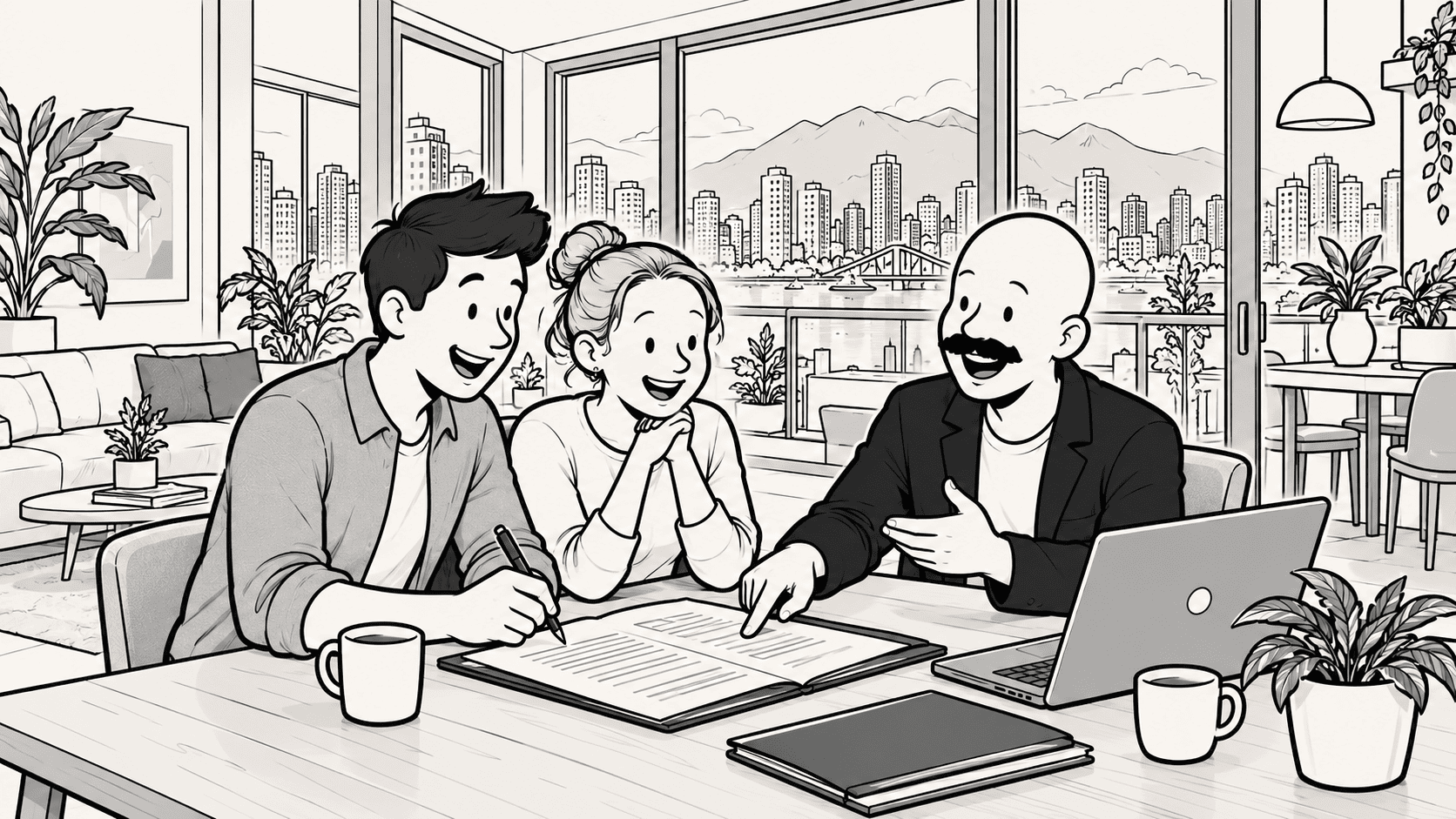
Once you've found the right home, it's time to put together an offer.
Before deciding on a price, it's important to understand how the property compares with similar homes that have recently sold.
You'll also need to consider the terms of the offer, including:
Purchase price: How much you're willing to pay for the property, and build an offer strategy
Deposit: Usually around 5% of the Purchase Price. Required upon Subjects Removal
Completion date: When the legal transfer of ownership takes place.
Possession date: When you get the keys and can move in.
Subjects: Conditions that need to be satisfied before the purchase becomes firm.
Once the offer is submitted, the seller may accept it, reject it or come back with a counteroffer. Negotiations aren't just about the purchase price. The dates, conditions and other terms can make a significant difference to whether a deal works for you. A well-structured offer reflects your budget, protects your interests through appropriate conditions and takes your personal circumstances into account.
Client Win: We worked with first-time buyers interested in a property in Vancouver's West Side. The property had been reduced to $975,000 & sat on the market for over 2 months, and the buyers decided to offer $958,000.
We helped them structure the offer with conditions for inspection, financing and strata-document review. We also coordinated the proposed completion and possession dates to have a couple of days gap in between that aligned with the Sale & move from their current place. The buyers were able to put forward an offer that reflected their budget and included the conditions and timing they wanted, at the same time accommodating the Sellers that made their offer more attractive for those Sellers, and therefore was accepted and our clients got the Home Of Their Dreams!
5. Subject removal: Making sure everything checks out

Once your offer is accepted, the subject removal period begins. Typical timing: Often around 5–7 days after an accepted offer, although the exact period depends on the contract. Some transactions have shorter or longer timelines.
This is when you complete the checks and conditions outlined in your contract before deciding whether to proceed with the purchase. Depending on the agreement, this may include:
Arranging a home inspection.
Confirming mortgage financing.
Reviewing strata documents.
Checking insurance availability and costs.
Investigating any concerns about the property or building.
Contacting Strata or the City for some clarifications
For a condo, reviewing strata documents is particularly important. These documents can provide insight into the building's maintenance history, financial position, upcoming repairs, insurance, bylaws and potential special levies.
A home inspection can also help identify issues that weren't obvious during a showing. If questions come up, you'll need to investigate them within the agreed subject removal period. Once you're satisfied with your due diligence and the applicable conditions have been met, you can decide whether to remove your subjects, and thats when the deal becomes Firm.
Client Win: Our buyers fell in love with a townhome in Kitsilano, and their offer was accepted. While reviewing the strata documents, we noticed missing meeting minutes and dug deeper, discovering that the strata had been discussing a major upcoming levy. We confirmed the potential cost and walked the buyers through what it would mean for them.
They still loved the home, so we went back to the sellers with a proposed price adjustment to account for the upcoming expense. The sellers agreed, and our buyers secured a great deal while knowing exactly what to expect. The planned work would also improve the building and, in the long run, help protect and enhance the value of their home.
6. Completion and possession: Getting the keys

Typical timing: Completion commonly takes place several weeks to a few months after subject removal. The exact timeline is negotiated in the contract and can vary. Most typical completions are between one & three months.
Once the deal becomes firm, you're officially on your way to becoming a homeowner. But there's still plenty to do before you get the keys. During this stage, you'll work with your mortgage broker and lawyer or notary to prepare for the legal transfer of ownership. Your lawyer or notary handles the transfer of funds, mortgage registration and other legal requirements. Happy to refer you to some of them best lawyers in the industry.
You'll also need to arrange insurance, book movers, set up utilities and prepare for the move.
It's important to understand the difference between completion and possession.
These dates can be the same, back-to-back or with a gap in between, depending on the contract and specific circumstances.
A final walkthrough may also be arranged before possession to check the property's condition and confirm that the agreed terms have been met.
Client Win: We want our buyers to feel prepared long before they get the keys. That’s why we include additional visits to the property in our contracts, allowing buyers to take photos, measure rooms, plan furniture layouts or bring in a contractor before Completion Day. We also help them prepare for homeownership by connecting them with the strata manager, advising on insurance and confirming that any agreed-upon repairs have been completed.
And then comes the best day of all: Possession Day! We coordinate the key transfer and meet our clients at their new home to celebrate the beginning of this exciting chapter.
Thinking about buying your first home in Vancouver?
You don't need to have everything figured out before reaching out. Sometimes, the best first step is simply sitting down and talking through what's possible.
Your First Home Starts Here
Download our free Home Buyers Guide - a practical resource to help you understand the home-buying process in Vancouver, from getting started to getting the keys.
At Team Toly & Josie, we believe in putting people before profit, community before competition, and service before sales.
Thinking about buying your first home? Let's grab a coffee and talk about it.
Team Toly & Josie | TRG Realty, Brokerage